> For the complete documentation index, see [llms.txt](https://docs.borndigital.ai/llms.txt). Markdown versions of documentation pages are available by appending `.md` to page URLs; this page is available as [Markdown](https://docs.borndigital.ai/insights/building-new-projects/analysis-project/2.-configure-parameters-and-prompts.md).
# 2. Configure parameters and prompts
Define what the AI should find in every record (parameters) and group the parameters into prompts.
* A **parameter** is one question the AI answers for every record – for example *Did the agent greet the customer?* or *What is the main topic?*
* A **prompt** groups parameters that the AI processes together. Only parameters that are part of a prompt are analysed.
## Create parameters
1. Open **Design** › **Parameters**.
2. Click **Create** and choose **Custom**.
3. Fill in the **Essential** tab:
* **Name** – it is saved in lowercase `snake_case`, for example `greeted`.
* **Language** of the definition.
* **Definition** – the instruction for the AI, for example *Return true if the agent greeted the customer and said the company name. Return false otherwise.*
* **Output format** – **String**, **Number**, **Boolean** or **JSON**.
* For String and Number, a **List of values** limits the answer to fixed choices (confirm each value with **Enter**). For String, a **Fallback value** is used when the answer is none of them; switch on **Enforce** to always replace such an answer with the fallback.
4. Click **Create**.
A parameter with the JSON output format
Which output format to use:
| Output format | Use it for | Example result |
| ------------- | ----------------------------------------------------------------------- | ------------------------------------- |
| **String** | Categories, short texts, summaries | `billing` |
| **Number** | Counts and scores | `3` |
| **Boolean** | Yes/no questions – describe in the definition when it is true and false | `true` |
| **JSON** | Several related values in one answer, for example a list of products | `{"products": ["loan", "insurance"]}` |
For a JSON parameter, describe the structure you expect in the **Definition**. **Enforce** cannot be used with JSON. For very long records, only the **Multi prompt behaviour** options that keep the object whole (first or last result) are offered – see [Parameters](/insights/workspace/design/parameters.md#custom).
**Import** loads parameters from a JSON file exported from another project. Predefined parameters are also available directly in prompts.
## Create a prompt
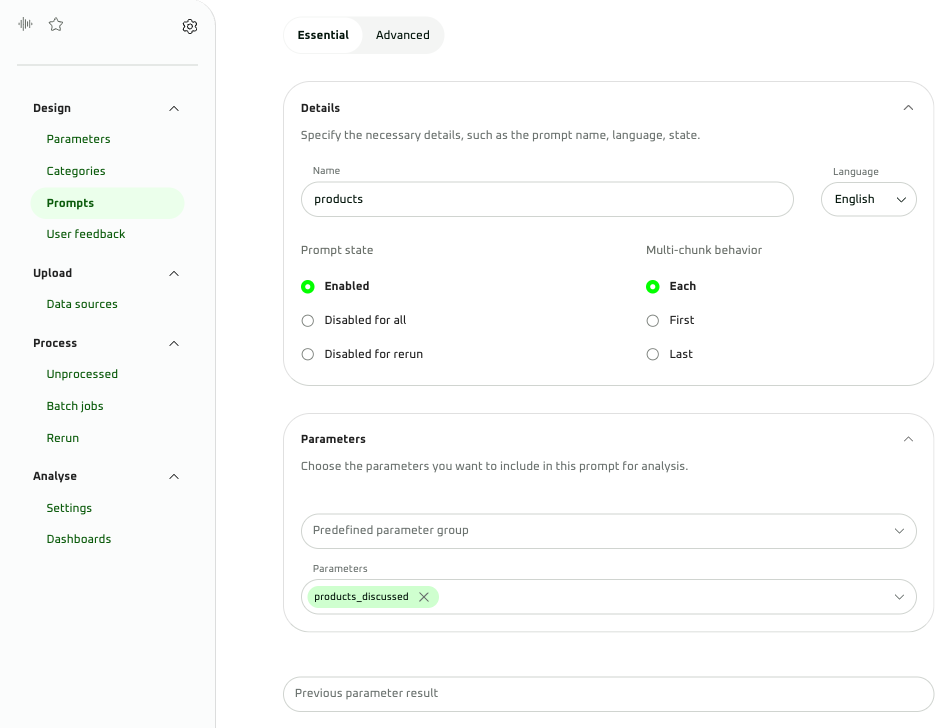
1. Open **Design** › **Prompts** and click **Create**.
2. Enter the **Name** and the **Language** in which the prompt is processed.
3. In **Parameters**, select your parameters – or a **Predefined parameter group**.
4. Click **Create**.
A prompt with one parameter
Optional settings, described in [Prompts](/insights/workspace/design/prompts.md):
* **Previous parameter result** – use the result of an earlier prompt (for example a summary) as the input of this one.
* **Advanced** tab – **LLM Instructions** for extra output requirements, **Conditions** to run the prompt only for some records, a **Custom provider** with its own model, and **LLM caching**.
{% hint style="info" %}
Start with a few parameters and a small batch of data. Check the results in your dashboard, sharpen the definitions and only then process all your data.
{% endhint %}